




正在起飛的奧斯丁市


分享到微信
請掃描以上二維碼
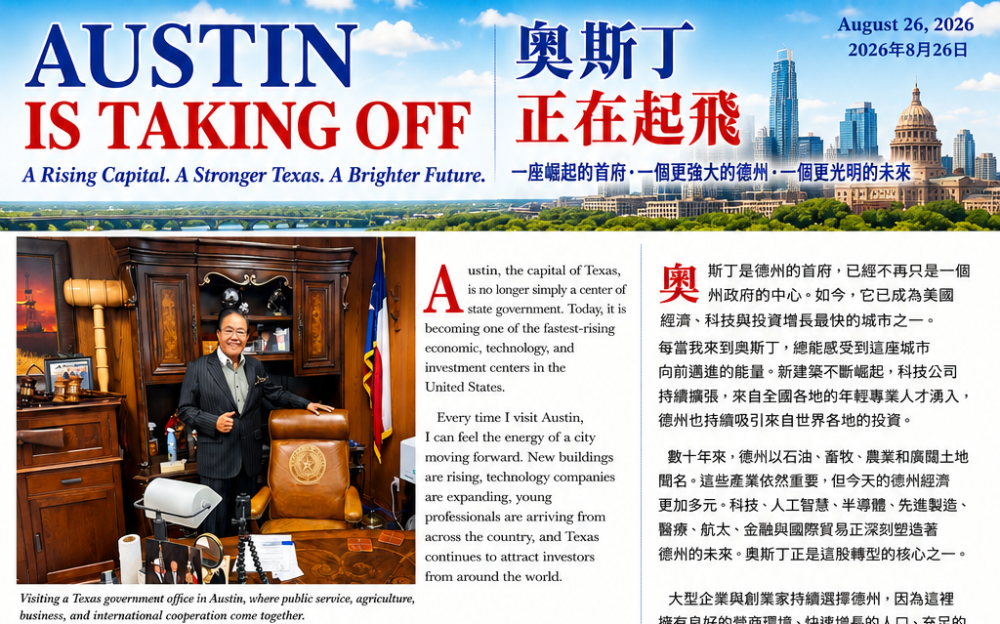
德州首府奧斯丁,正在經歷一場前所未有的蛻變。
過去,人們提到奧斯丁,首先想到的是州政府所在地、德州大學,以
走進今天的奧斯丁,可以很清楚地感受到城市正在「起飛」。
新的辦公大樓不斷出現,新的住宅社區快速形成,來自美國各地甚至
目前,奧斯丁市人口已突破百萬,而整個大奧斯丁都會區的人口成長
多年來,Dell一直是奧斯丁科技產業的重要象徵。近年來,Te
特別值得注意的是半導體產業。
Samsung在奧斯丁北部Taylor地區大規模投資先進半導
這是一個非常重要的轉變。
過去幾十年,世界談到美國科技產業,幾乎一定想到加州矽谷。但是
而奧斯丁,正站在這股浪潮的中心。
一座真正的國際城市,也必須擁有與世界連接的能力。
奧斯丁國際機場正在進行大規模擴建,希望增加航廈容量、改善交通
奧斯丁還有另一個非常重要的優勢——年輕人才。
德州大學奧斯丁分校每年培養大量工程、電腦、商業及科研人才。這
人才帶來企業,企業帶來資金,資金又創造更多就業機會。
這正是城市起飛最重要的力量。
當然,快速發展也帶來不少挑戰。
房價與租金上漲、道路交通日益繁忙,電力、水資源、公共交通及城
因此,奧斯丁未來真正的考驗,不只是「能不能繼續成長」,而是「
從休斯敦、達拉斯、聖安東尼奧到奧斯丁,德州的主要城市正在形成
奧斯丁位於這個版圖的中心。
它既是德州的政治首府,也是正在快速崛起的科技首府。
世界正在改變,企業的選擇也正在改變。
過去,人們追逐的是矽谷。
今天,越來越多的企業家、工程師和投資者,正在把目光轉向德州。
奧斯丁這架飛機,已經離開跑道。
而這座城市究竟能夠飛得多高、飛得多遠,現在才剛剛開始。
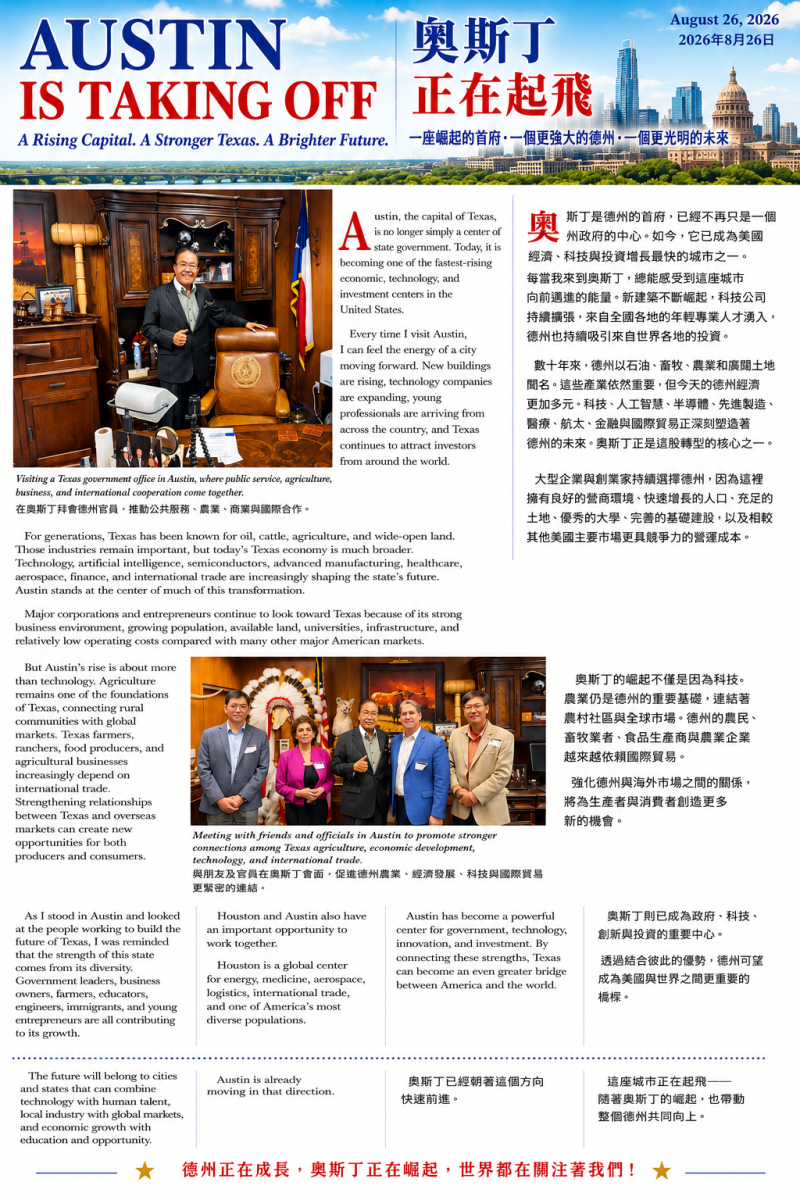
Austin Is Taking Off
Austin, the capital of Texas, is undergoing an extraordinary transformation.
In the past, when people thought of Austin, they often thought first of the state government, the University of Texas, and a youthful city known for music and culture. Today, Austin has moved far beyond that traditional image. It is rapidly becoming one of the most closely watched centers of technology, innovation, and investment in the United States.
Walking through Austin today, one can clearly feel that the city is “taking off.”
New office towers continue to rise, new residential communities are expanding, and talented people from across the United States and around the world continue to arrive. Technology companies, semiconductor firms, artificial intelligence ventures, and advanced manufacturers are building a powerful new industrial ecosystem.
Austin’s population has now surpassed one million, while the greater Austin metropolitan area is growing even faster. Behind this population growth are expanding employment opportunities, corporate investment, and the concentration of highly skilled talent.
For many years, Dell has been one of the symbols of Austin’s technology industry. More recently, Tesla, Apple, Samsung, AMD, NXP, Applied Materials, and many other companies have expanded their presence in Austin and the surrounding region.
The semiconductor industry is especially important.
Samsung’s major investment in advanced semiconductor manufacturing in Taylor, north of Austin, is strengthening Texas’ position in the global chip supply chain. At the same time, chip designers, equipment manufacturers, and suppliers continue to move into the region.
As a result, Austin is no longer simply a software city. It is increasingly becoming a center for artificial intelligence, semiconductors, robotics, aerospace, biotechnology, and advanced manufacturing.
This is a very important transformation.
For decades, when the world talked about American technology, Silicon Valley in California was almost always the first place that came to mind. Today, however, America’s technology map is being redrawn.
Companies are paying greater attention to land costs, taxes, energy availability, workforce quality, infrastructure, and the overall business environment. Texas has therefore become an increasingly attractive destination.
And Austin stands at the center of this new wave.
A truly international city must also have strong connections with the rest of the world.
Austin-Bergstrom International Airport is undergoing major expansion to increase capacity, improve facilities, and accommodate greater domestic and international travel. These investments are not only designed for today’s passengers; they are preparing Austin for the growth of the next ten or twenty years.
Austin also has another major advantage: young talent.
The University of Texas at Austin produces large numbers of graduates in engineering, computer science, business, research, and many other fields. These young professionals, together with experienced workers arriving from California, New York, Seattle, and other parts of the world, have created a dynamic environment filled with entrepreneurial energy.
Talent attracts companies.
Companies attract capital.
Capital creates jobs and opportunities.
This is one of the most important forces driving a city’s rise.
Rapid development, however, also brings serious challenges.
Housing costs and rents have increased. Traffic has become heavier. Electricity, water, public transportation, roads, and other essential infrastructure are all under greater pressure.
If economic growth moves faster than infrastructure can support, quality of life can suffer.
Therefore, Austin’s real challenge is no longer simply whether it can continue to grow. The greater question is whether it can turn rapid expansion into balanced and sustainable prosperity.
From Houston and Dallas to San Antonio and Austin, the major cities of Texas are forming an increasingly powerful economic network.
Energy, healthcare, finance, aerospace, artificial intelligence, semiconductors, advanced manufacturing, and international trade are becoming more closely connected. A new center of American economic strength is emerging in Texas.
Austin sits near the heart of this transformation.
It is not only the political capital of Texas.
It is increasingly becoming one of its technology capitals as well.
The world is changing, and the choices made by businesses and investors are changing with it.
In the past, people followed Silicon Valley.
Today, more entrepreneurs, engineers, companies, and investors are turning their eyes toward Texas.
Austin has already left the runway.
The question now is not whether the city can take off.
The question is how high—and how far—it can fly.
分享到微信
請掃描以上二維碼