







巴基斯坦和印度可能因水而开战


分享到微信
請掃描以上二維碼
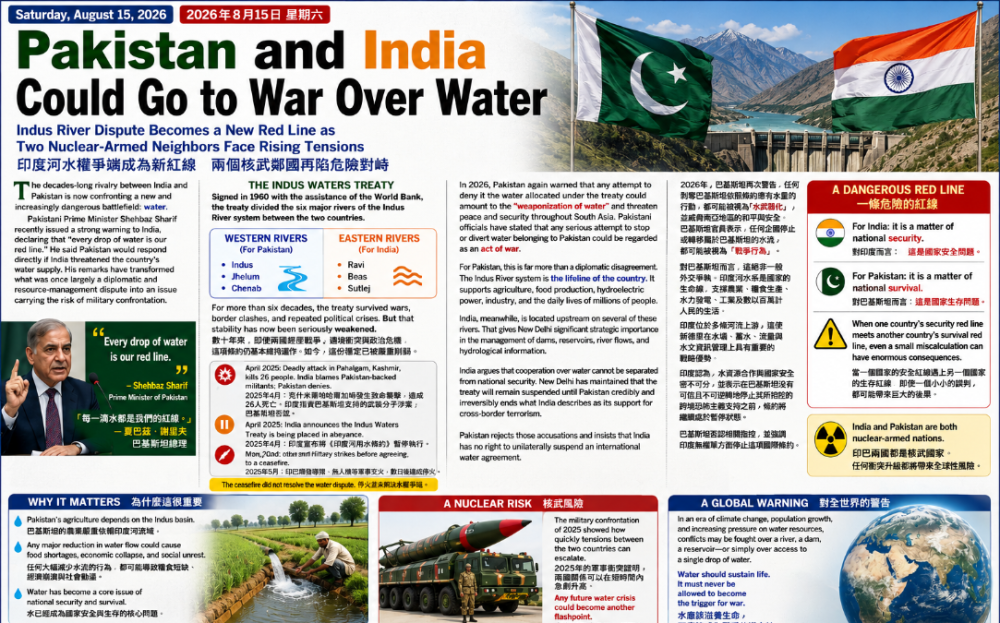
印度河水权成為新红线 南亚两个核武国家再陷危险对峙
印度与巴基斯坦之间长达数十年的宿怨,如今正出现一个更加令人忧
巴基斯坦总理夏巴兹・谢里夫近日公开向印度发出强硬警告,称「每
印巴水权争端的核心,是1960年在世界银行协助下签署的《印度
然而,2025年4月克什米尔帕哈尔加姆发生造成26人死亡的袭
到了2026年,水资源问题并没有随着军事停火而降温。
巴基斯坦政府今年6月再次警告,任何企图剥夺巴基斯坦依照条约应
对巴基斯坦而言,这绝非一般外交争执。
印度河水系是巴基斯坦农业、粮食生產、水力发电以及数以百万计人
问题因此变得极為危险:
对印度而言,这是国家安全问题;对巴基斯坦而言,这是国家生存问
当安全与生存两种「红线」相遇,任何误判都可能造成无法控制的后
印度和巴基斯坦都是拥有核武器的国家。2025年的军事冲突已经
当然,目前仍不能断言印度和巴基斯坦一定会「為水而战」。印度现
但是,比真正「断水」更值得警惕的,是水已经逐渐成為两国政治、
世界进入气候变迁、水资源短缺和人口快速增长的时代,未来国与国
印巴两国今天面对的问题,也许正是全世界的一个警告:
水原本应该滋养生命,不能让它成為战争的导火线。
对印度和巴基斯坦而言,重新建立水资源谈判与危机沟通机制,不只
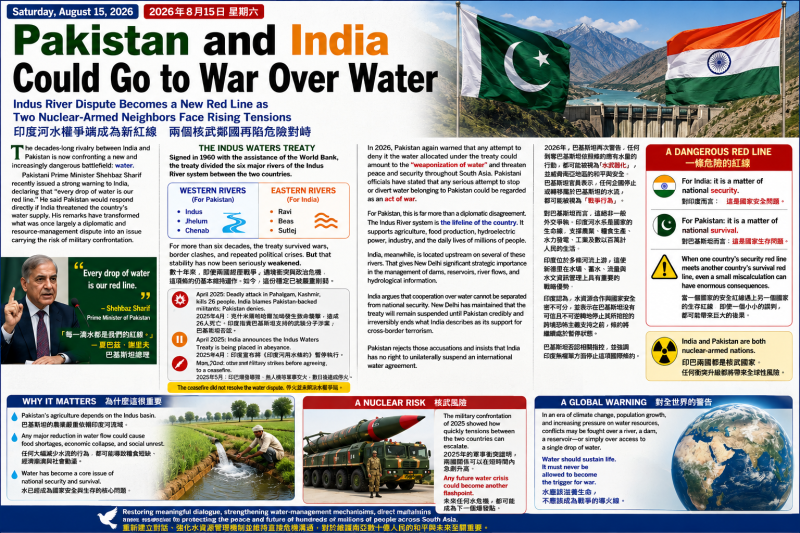
Pakistan and India Could Go to War Over Water
Indus River Dispute Becomes a New Red Line as Two Nuclear-Armed Neighbors Face Rising Tensions
Saturday, August 15, 2026
The decades-long rivalry between India and Pakistan is now confronting a new and increasingly dangerous battlefield: water.
Pakistani Prime Minister Shehbaz Sharif recently issued a strong warning to India, declaring that “every drop of water is our red line.” He said Pakistan would respond directly if India threatened the country’s water supply. His remarks have transformed what was once largely a diplomatic and resource-management dispute into an issue carrying the risk of military confrontation.
At the center of the dispute is the Indus Waters Treaty, signed in 1960 with the assistance of the World Bank. Under the agreement, the six major rivers of the Indus River system were divided for use by the two countries. India was given primary rights over the eastern rivers—the Ravi, Beas, and Sutlej—while Pakistan received primary rights over the western rivers—the Indus, Jhelum, and Chenab.
For more than six decades, the treaty survived wars, border clashes, and repeated political crises between the two countries. It was often regarded as one of the rare examples of successful cooperation between India and Pakistan.
That stability, however, has now been seriously weakened.
Following the deadly attack in Pahalgam, Kashmir, in April 2025, which killed 26 people, India accused Pakistan-backed militants of involvement. Pakistan denied the allegations. India subsequently announced that it was placing the Indus Waters Treaty in abeyance.
Relations deteriorated rapidly. In May 2025, the two countries exchanged missile, drone, and other military strikes before eventually agreeing to a ceasefire.
But the ceasefire did not resolve the water dispute.
In 2026, Pakistan again warned that any attempt to deny it the water allocated under the treaty could amount to the “weaponization of water” and threaten peace and security throughout South Asia. Pakistani officials have stated that any serious attempt to stop or divert water belonging to Pakistan could be regarded as an act of war.
For Pakistan, this is far more than a diplomatic disagreement.
The Indus River system is the lifeline of the country. It supports agriculture, food production, hydroelectric power, industry, and the daily lives of millions of people. Much of Pakistan’s farming economy depends on water flowing through the Indus basin.
India, meanwhile, is located upstream on several of these rivers. That gives New Delhi significant strategic importance in the management of dams, reservoirs, river flows, and hydrological information.
India argues that cooperation over water cannot be separated from national security. New Delhi has maintained that the treaty will remain suspended until Pakistan credibly and irreversibly ends what India describes as its support for cross-border terrorism.
Pakistan rejects those accusations and insists that India has no right to unilaterally suspend an international water agreement.
This is what makes the present confrontation so dangerous.
For India, the issue has become one of national security. For Pakistan, it has become one of national survival.
When one country’s security red line meets another country’s survival red line, even a small miscalculation can have enormous consequences.
India and Pakistan are both nuclear-armed nations. The military confrontation of 2025 demonstrated how quickly a terrorist attack or border crisis can escalate into direct military action.
If water now becomes another strategic weapon, South Asia will face an additional and potentially even more dangerous flashpoint.
At this stage, it would be an exaggeration to say that India and Pakistan are certain to go to war over water. Geography, reservoir capacity, engineering limitations, and international pressure all limit India’s ability to simply shut off the major rivers flowing into Pakistan.
But the greater danger is not necessarily the immediate possibility of completely stopping the water.
The greater danger is that water itself is becoming part of the political, diplomatic, and military confrontation between the two countries.
The world is entering an era of climate change, population growth, extreme weather, and increasing pressure on limited water resources. Future conflicts between nations may no longer be fought only over oil, territory, ideology, or borders.
They may also be fought over a river, a dam, a reservoir—or simply over access to a single drop of water.
The growing India-Pakistan water dispute therefore carries a warning far beyond South Asia.
Water should sustain life. It must never be allowed to become the trigger for war.
For India and Pakistan, restoring meaningful dialogue, strengthening water-management mechanisms, and maintaining direct crisis communications are no longer merely diplomatic choices.
They may be essential to protecting the peace and future of hundreds of millions of people across South Asia.
分享到微信
請掃描以上二維碼