






中美外长在马尼拉会晤


分享到微信
請掃描以上二維碼
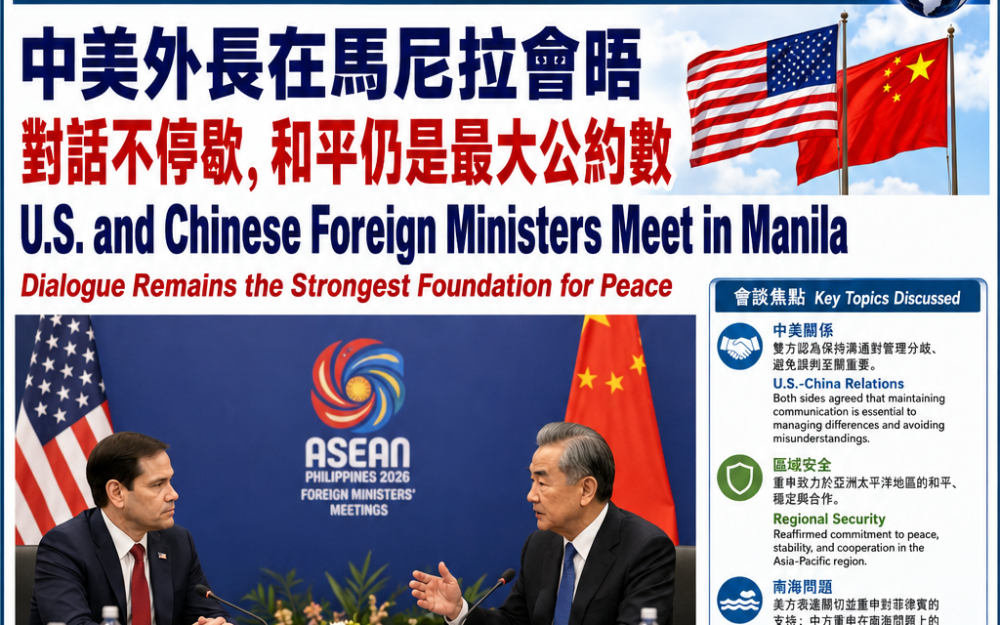
对话不停歇,和平仍是最大公约数
在菲律宾马尼拉举行的东盟(ASEAN)系列外长会议期间,美国
儘管中美在贸易、科技、安全及地缘政治等方面仍存在重大分歧,但
值得注意的是,南海问题依然是此次会谈的重要议题。美方重申对菲
当前世界正面临地区冲突、能源安全、全球经济復甦及供应链重组等
世界期待,中美两国在竞争中保持理性,在分歧中寻求合作,在挑战
U.S. and Chinese Foreign Ministers Meet in Manila
Dialogue Remains the Strongest Foundation for Peace
During the ASEAN Foreign Ministers’ Meetings in Manila, Philippines, U.S. Secretary of State Marco Rubio and Chinese Foreign Minister Wang Yi held a bilateral meeting lasting approximately 90 minutes. The discussion marked one of the most significant high-level diplomatic engagements between the United States and China in recent months.
The two leaders exchanged views on a wide range of issues, including U.S.-China relations, regional security, the South China Sea, the Taiwan Strait, economic cooperation, and preparations for a possible meeting between the two presidents later this year. Although differences remain on many strategic issues, both sides agreed that maintaining open channels of communication is essential to preventing misunderstandings and preserving stability.
The South China Sea was a central topic of discussion. The United States reaffirmed its commitment to regional security and its alliance with the Philippines, while China reiterated its longstanding position on territorial issues. Despite their differences, both governments emphasized the importance of managing disputes through diplomacy and avoiding actions that could increase tensions.
At a time when the world continues to face geopolitical conflicts, economic uncertainty, supply chain challenges, and security concerns, constructive engagement between the world’s two largest economies carries global significance. Every meaningful dialogue between Washington and Beijing helps reduce the risk of confrontation and creates opportunities for cooperation on issues of shared interest.
Dialogue alone cannot resolve every disagreement, but the absence of dialogue often allows conflicts to grow. The international community hopes that both nations will continue to communicate with mutual respect, manage their differences responsibly, and expand cooperation wherever possible.
Peace, stability, and prosperity depend not only on competition, but also on wisdom, restraint, and the willingness to keep talking. As the United States and China continue their engagement, the world watches with cautious optimism, hoping that diplomacy will prevail over confrontation.
分享到微信
請掃描以上二維碼