






美伊和平是否在望?


分享到微信
請掃描以上二維碼
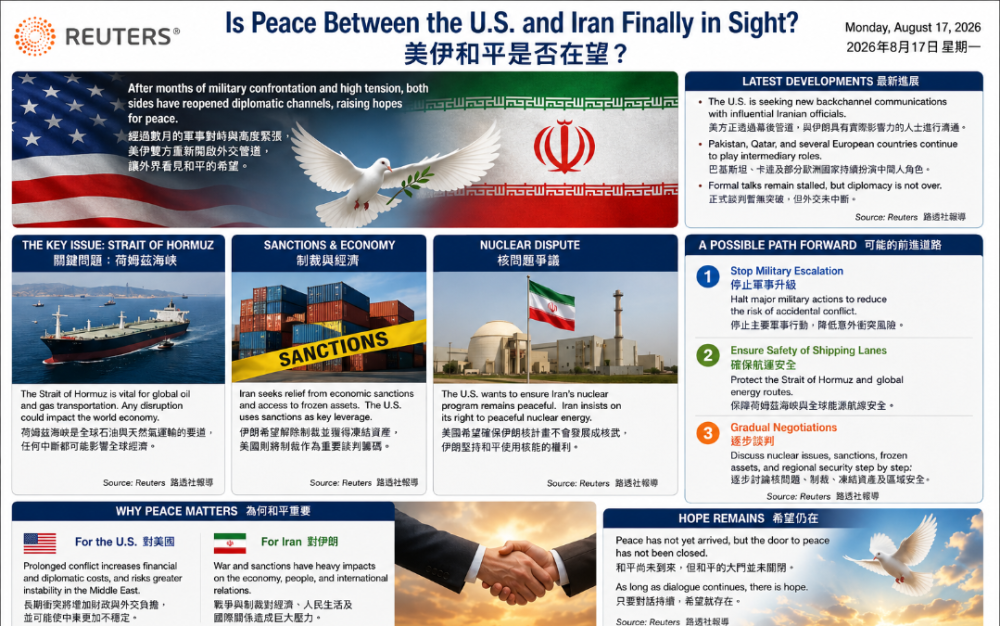
在经歷数月的军事冲突与高度紧张之后,美国与伊朗之间是否可能重
今年六月,美国与伊朗曾在巴基斯坦、卡达等国斡旋下,尝试建立临
目前最大的争议之一,是具有全球战略重要性的荷姆兹海峡。这条海
伊朗希望美国放宽经济制裁、解除部分金融与港口限制,并处理遭冻
值得注意的是,虽然正式谈判仍没有明显突破,但外交管道并没有完
最近的消息显示,美方正在尝试透过第三方及非正式管道,与伊朗方
这代表一个重要现象:双方在公开场合可以非常强硬,但在幕后仍然
然而,要真正达成和平,美伊之间仍有几座大山必须跨越。
首先是核问题。美国希望确保伊朗核计画不会发展成核武能力;伊朗
其次是经济制裁。长期制裁对伊朗经济造成巨大压力,而制裁也是美
第三是荷姆兹海峡与中东安全。任何新的协议,都必须让国际航运恢
更重要的是,双方已经累积多年不信任。即使领导人愿意谈判,如何
因此,目前最现实的道路,可能并不是立即签署一份全面永久和平协
第一步,可以先停止主要军事行动,降低擦枪走火的风险。
第二步,保障荷姆兹海峡与国际能源航线安全。
第三步,再逐步讨论核问题、制裁、冻结资產以及区域安全安排。
这样的「先停火、后谈判;先建立互信、再处理重大问题」模式,虽
战争没有真正的赢家。
对美国而言,长期军事冲突将增加财政与外交负担,也可能使整个中
因此,双方其实都有寻找出口的需要。
今天我们再问:美伊和平是否在望?
答案也许是:和平还没有真正到来,但和平的大门并没有关闭。
真正考验两国领导人的,不是谁能发表最强硬的声明,也不是谁能在
如果有一天,谈判桌上的声音能够逐渐取代战场上的炮火,那麼美伊
和平也许仍然遥远,但只要对话没有停止,希望就仍然存在。
Is Peace Between the United States and Iran Finally in Sight?
Monday, August 17, 2026
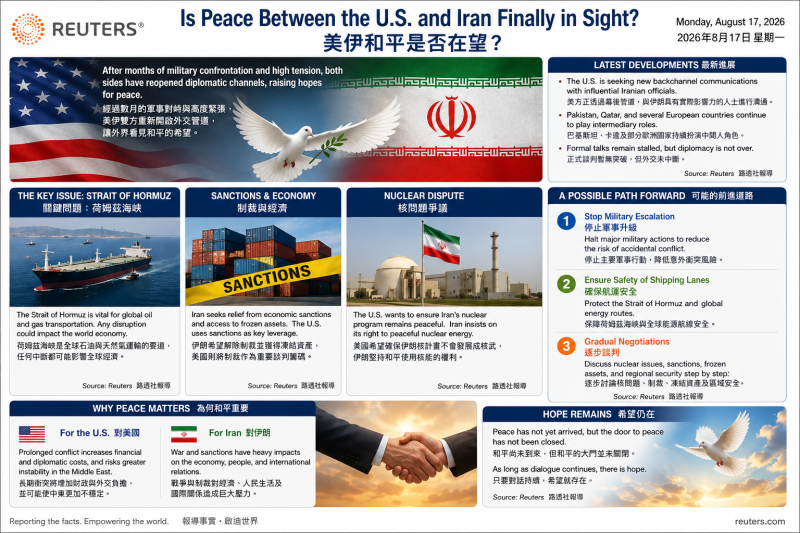
After months of military confrontation and heightened tension, one of the most important questions facing the international community is whether the United States and Iran can return to the negotiating table. As we move into mid-August, both sides continue to take strong public positions, but renewed diplomatic contacts and unofficial communication channels have created a small but meaningful opening for peace.
In June, the United States and Iran attempted to establish a temporary ceasefire and negotiating framework with the assistance of countries including Pakistan and Qatar. The goal was to create enough time and space for discussions on a longer-term settlement. However, major disagreements over compliance, military actions, sanctions, and security quickly weakened the arrangement. By July, the ceasefire mechanism had largely collapsed, and relations once again entered a dangerous period.
One of the most important issues remains the Strait of Hormuz, one of the world’s most strategically important waterways. A significant portion of the world’s oil and natural gas passes through this narrow passage. Any military confrontation or disruption there could affect not only the United States and Iran, but also global energy markets and the international economy.
Iran wants the United States to ease economic sanctions, reduce restrictions affecting its ports and financial system, and address frozen Iranian assets overseas. The United States, meanwhile, continues to emphasize freedom of navigation through the Strait of Hormuz, while also raising concerns about Iran’s nuclear program and regional security.
Despite the lack of a major breakthrough in formal negotiations, diplomatic channels have not completely disappeared.
Recent developments suggest that the United States is continuing to explore communication through third parties and unofficial channels. Pakistan, Qatar, and several European countries may continue to play important intermediary roles. There are also indications that Washington is seeking ways to communicate with influential figures inside Iran through private channels.
This reveals an important reality: both sides may speak forcefully in public, but behind the scenes they understand that military confrontation alone cannot provide a lasting solution.
Still, several major obstacles stand in the way of genuine peace.
The first is the nuclear issue. The United States wants assurances that Iran’s nuclear program will not lead to the development of nuclear weapons, while Iran continues to defend its right to peaceful nuclear energy.
The second issue is economic sanctions. Years of sanctions have placed enormous pressure on Iran’s economy, but sanctions also remain one of Washington’s most important negotiating tools.
The third issue involves the Strait of Hormuz and broader Middle East security. Any future agreement must protect international shipping while reducing the possibility of direct military confrontation between the United States and Iran.
Perhaps the greatest challenge, however, is the deep lack of trust that has developed over many years. Even if political leaders agree to negotiate, both sides will still have to find a credible way to ensure that any agreement is actually implemented.
For this reason, the most realistic path may not be an immediate and comprehensive peace treaty. A step-by-step approach may offer a better chance of success.
The first step could be a halt to major military operations and a reduction in the risk of accidental escalation.
The second could be the protection of the Strait of Hormuz and international energy shipping routes.
The third could involve gradual negotiations over the nuclear issue, sanctions, frozen assets, and broader regional security arrangements.
This approach—ceasefire first, negotiations second; confidence-building first, major agreements later—may not bring instant peace, but it could provide the most practical road forward.
War rarely produces true winners.
For the United States, a prolonged conflict would increase military, financial, and diplomatic burdens while threatening greater instability throughout the Middle East. For Iran, continued war and sanctions would place even greater pressure on its economy, its people, and its international relationships.
For that reason, both sides have strong reasons to search for an exit from confrontation.
So today we ask again: Is peace between the United States and Iran finally in sight?
The answer may be this: peace has not yet arrived, but the door to peace has not been closed.
The real test of leadership is not who can make the strongest statement or claim a temporary advantage on the battlefield. It is who has the wisdom and courage to defend national interests while also finding a way to stop the fighting.
If one day the sound of negotiations can gradually replace the sound of weapons, then genuine peace between the United States and Iran may finally begin.
Peace may still be distant, but as long as dialogue continues, hope remains.
分享到微信
請掃描以上二維碼