






习近平访美之意义


分享到微信
請掃描以上二維碼
根据目前公开资讯,美国总统川普表示,中国国家主席习近平预定於
这次访问如果按计画成行,其意义远远超过一次普通的元首互访。当
第一,是為中美关係建立新的高层沟通渠道。
川普今年5月访华后,两国元首保持直接互动;习近平回访华盛顿,
第二,经贸问题仍将是核心。
美中之间的关税、稀土与关键矿產、农產品、半导体以及供应链问题
第三,台湾问题仍是最敏感的政治与安全议题。
今年5月川普与习近平北京会谈前后,台湾问题已被视為中美高层对
第四,人工智慧已成為新的中美竞争前线。
目前美中竞争已不只是关税与商品贸易,更延伸到AI、先进晶片、
第五,这次峰会的真正价值可能不是消除竞争,而是管理竞争。
中美之间在制度、科技、安全与全球影响力方面的竞争不可能因一次
从全球角度来看,中美关係已不只是华盛顿与北京两个政府之间的事
因此,习近平此次访美最大的意义,也许不在於能签下多少协议,而
在今天动盪不安的国际局势中,如果北京与华盛顿能重新建立更稳定
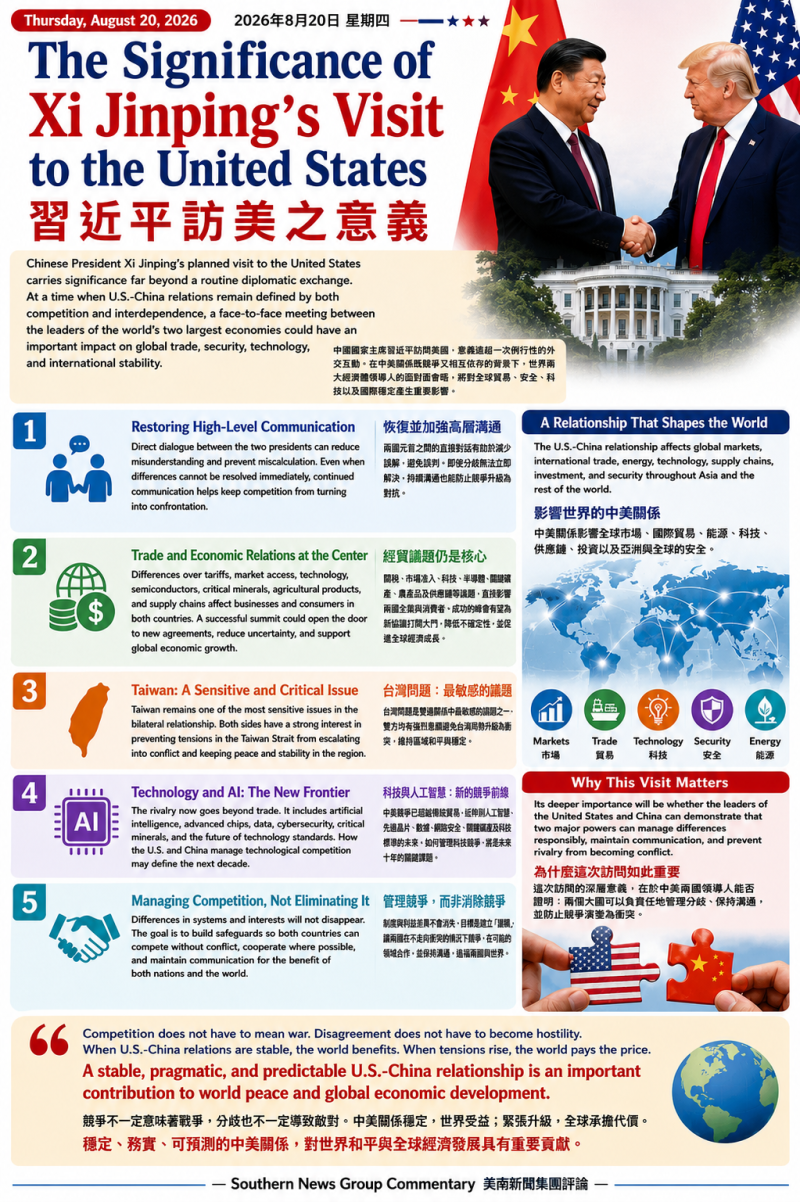
The Significance of Xi Jinping’s Visit to the United States
Chinese President Xi Jinping’s planned visit to the United States carries significance far beyond a routine diplomatic exchange. At a time when U.S.-China relations remain defined by both competition and interdependence, a face-to-face meeting between the leaders of the world’s two largest economies could have an important impact on global trade, security, technology, and international stability.
The first major significance of the visit is the restoration and strengthening of high-level communication.
Despite serious disagreements between Washington and Beijing, direct dialogue between the two presidents can help reduce misunderstanding and prevent miscalculation. When relations between major powers become tense, communication at the highest level is especially important. Even when differences cannot be resolved immediately, continued dialogue can help keep competition from turning into confrontation.
Second, trade and economic relations will remain at the center of the discussions.
The United States and China continue to have major differences over tariffs, market access, advanced technology, semiconductors, critical minerals, agricultural products, and global supply chains. These issues directly affect businesses, consumers, farmers, manufacturers, and financial markets in both countries.
A successful summit could create opportunities for new agreements, reduce uncertainty, and provide businesses with a clearer understanding of the direction of future U.S.-China economic relations.
Third, Taiwan remains one of the most sensitive issues in the bilateral relationship.
Beijing considers Taiwan a core national interest, while Washington continues to maintain its long-standing policy and unofficial relationship with Taiwan. Because the Taiwan Strait is one of the most closely watched security flashpoints in the world, both sides have a strong interest in preventing tensions from escalating into military conflict.
Careful communication between the two leaders could therefore play an important role in maintaining peace and stability in the region.
Fourth, artificial intelligence and advanced technology have become a new frontier of U.S.-China competition.
The rivalry between the two countries is no longer limited to tariffs and traditional trade. It now includes artificial intelligence, advanced chips, data, telecommunications, cybersecurity, critical minerals, and the future of global technology standards.
How the United States and China manage technological competition may become one of the defining questions of the next decade. Cooperation may be possible in some areas, but strategic competition is likely to continue.
Fifth, the real value of this visit may not be the elimination of competition, but the management of competition.
The United States and China have different political systems, strategic interests, and global priorities. These differences will not disappear after one summit. The more realistic goal is to establish safeguards that allow both countries to compete without moving toward direct conflict.
Competition does not have to mean war. Disagreement does not have to become hostility. National interests can differ while economic cooperation, diplomatic communication, and people-to-people exchanges continue.
The importance of U.S.-China relations extends far beyond Washington and Beijing. The relationship affects global markets, international trade, energy, technology, supply chains, investment, and security throughout Asia and the rest of the world.
When U.S.-China relations are stable, the international community benefits. When tensions rise sharply, the economic and political consequences are felt around the globe.
For this reason, the greatest significance of Xi Jinping’s visit may not be measured simply by the number of agreements signed or announcements made.
Its deeper importance will be whether the leaders of the United States and China can demonstrate that two major powers can manage differences responsibly, maintain communication, and prevent rivalry from becoming conflict.
At a time of uncertainty in the international system, a more stable, pragmatic, and predictable relationship between Washington and Beijing would itself be an important contribution to world peace and global economic development.
分享到微信
請掃描以上二維碼